-
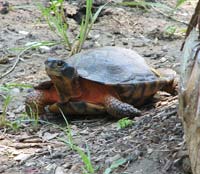
- Clemmys Insculpa LeConte
-
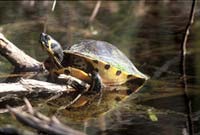
- Chrysemys Floridana LeConte
LeConte Turtles
Three turtles carry the LeConte name.
The first is the Clemmys Insculpa LeConte or Wood Turtle. This turtle
spends most of its time in wooded areas. It is also semi-aquatic and can
be seen in streams, rivers and ponds. Space reaction experiments have
shown the more aquatic a turtle species is the less likely it is to be
afraid of heights. The North American wood turtle shows more fear of
heights than its more aquatic cousin, the Spotted Turtle. This
particular turtle is said to have the
intelligence of a rat and thus be one of the most intelligent of the
species. It is also a great climber and escape artist. Wood turtles are
often solitary and will create alpha-beta rankings. Passive
turtles can have a problem getting food because more dominant
individuals will keep them at bay.
The Florida Cooter or Chrysermys Floridana LeConte gets its name from “Kuta”,
the word for turtle in the Bambara and Malinke languages, brought to
America by African slaves. It is about 12 inches in size and is often
found sunning itself beside ponds and rivers in Florida. Female cooters
lay approximately 20 eggs in May or June. Only adults, of the species,
can lay eggs.
The Kinosternon Sonoriense LeConte or Sonora Mud Turtle was first
discovered in 1854. It is found mainly in rocky streams, creeks and
rivers, in southeastern and central Arizona, but can also be seen in
ditches, ponds and cattle tanks. Although aquatic, it is known to travel
between bodies of water. When threatened it emits a foul smelling musk.
It eats some plant material but prefers frogs, insects, snails and fish.
Eggs are laid in an underground nest.
You’ll be surprised to discover how many plants, animals etc. have been
named for members of the LeConte family. To get an overview go the
“Discovery” page.