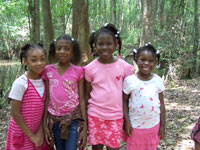
- Riceboro Vacation Bible School visit
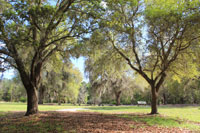
- Homesite and Garden View
Plan Your Visit
The LeConte-Woodmanston Plantation and Botanical Garden National Historic
Site is open daily to the public for hiking, picnicking and self-guided
garden tours. Guided
tours are available by appointment only. No motorized vehicles are allowed on trails.
The gates are intended to protect this historic site with its fragile system
of earthen dikes by excluding vehicles. Pedestrians are invited to explore.
We apologize for any inconvenience. Restroom facilities and picnic areas are
always open to the public and are handicapped accessible. Check the
news page
frequently for current site conditions.
Contact us for more information or to schedule a tour.
In 1760 John Eatton LeConte established Woodmanston, a 3,300 acre inland
swamp rice plantation along the headwaters of the South Newport River in
present day Liberty County, Georgia. His son, Louis LeConte moved into the
family’s hunting lodge in 1811. Here he pursued his scientific interests and
established Georgia’s first botanical garden. Today Louis LeConte’s
world-famous 19th century gardens are being re-created with historic roses
and bulbs as well as a Georgia collection of camellias combined with a
sampling of the historic camellias Louis knew. A small LeConte pear orchard
commemorates its introduction as a cultivar in 1856 by Louis’s brother, John
Eatton LeConte. To read more about our native, exotic and historic plants
check our “Gardens”
and “Garden History” pages.
Visitors experience the serenity of the Avenue of Oaks, see the foundations
of Louis’s home, view a replica slave cabin and stroll through the cypress
forest on a mile-long interactive trail
along historic earthen rice dikes. The intricate system of dikes and canals
includes a replica sluice gate used to impound the water of
BullTown Swamp for rice cultivation.
LeConte Woodmanston is on the National Register of Historic Places. It is a
Coastal Georgia Greenway
Trailhead as well as a part of The Liberty Trail, East Coast Camellia Trail
and the Coastal Georgia Birding Trail. It offers something for everyone
whether you’re a gardener, wildlife enthusiast, bird watcher, nature lover
or history seeker!
You’ll find a map and directions on the “Contact Us” page.