-
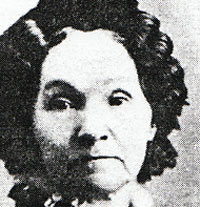
- Jane LeConte
LeConte Women
When Louis LeConte died in 1838, it was the beginning of the end for his
famous botanical gardens, but that particular LeConte legacy lived on
through his daughters, Jane and Ann.
By the age of 16, four years after the death of her mother, Jane LeConte had
assumed the duties of the mistress of the household. When her father died,
and with her brothers gone off to college, she also took over the management
of the plantation.
After marrying John M.B. Harden of Liberty County in 1834, she built a
home on her inherited portion of Woodmanston called Halifax or “Harden
Place.” Jane established a garden that perhaps rivaled her father’s. One eye
witness wrote “Never have I seen japonicas more beautiful-more absolutely
more exquisitely perfect, and I have walked all day in the magnificent
groves of japonicas in the Middleton Gardens in South Carolina.” Joseph
LeConte’s daughter, Emma, wrote of her visits to Harden Place: “…a large
square with a circular mound in the midst in three diminishing tiers…in
this garden was every known variety of camellia…great bushes like
trees…huge azalea bushes and many other shrubs and daffodils, jonquils and
narcissi and many other bulbs…more flowers than I can remember..! As her
father before her, Jane planted long Cherokee Rose hedges. Even today, these
can be found in abundance along the Barrington Ferry Road frontage of what
was once Halifax.
Jane took her children to Columbia, SC to be
educated but returned to Halifax to protect the property at the outbreak of
the Civil War. The plantation was occupied by Federals on several occasions
and Joseph LeConte made an arduous journey to rescue her and the family
papers. These were lost on the return trip during a Federal raid.
Widowed, Jane LeConte Harden went with her brothers John and Joseph,
to California after the Civil War, and there she died in 1876.
Ann was the youngest of the Louis LeConte children and only two years old
when her mother died. Also inheriting her father’s love of trees, plants and
flowers, Ann later shared her rather extensive horticultural and floral
knowledge in published writings, using the pen name, “Native Flora.”
She wrote for an agricultural
journal known as Soil of the South during the years 1852-54. She
also wrote for The Southern Cultivator. Commenting on a letter by
her, published in the latter journal in May 1953, Dr James Stokes stated:
“…she develops in a masterful manner, the methods of propagating the
Camellia. She displayed an excellent acquaintance with the native flora of
Georgia. It is not surprising that she chose the pseudonym “Native Flora.”
Ann married Dr. Josiah Peter Stevens and moved to Walthourville, Georgia,
where she established a garden that was said to be quite large and very
famous locally about 1840. Ann and her family moved to Macon before the War
had seriously impacted Liberty County. She died and was buried in Macon,
with her husband and three daughters. A six-page obituary honored Ann
LeConte Stevens as a person held in the highest esteem, though frail, a
lover of beauty and order, a woman of deep piety, intelligence, discipline
and kindness.